

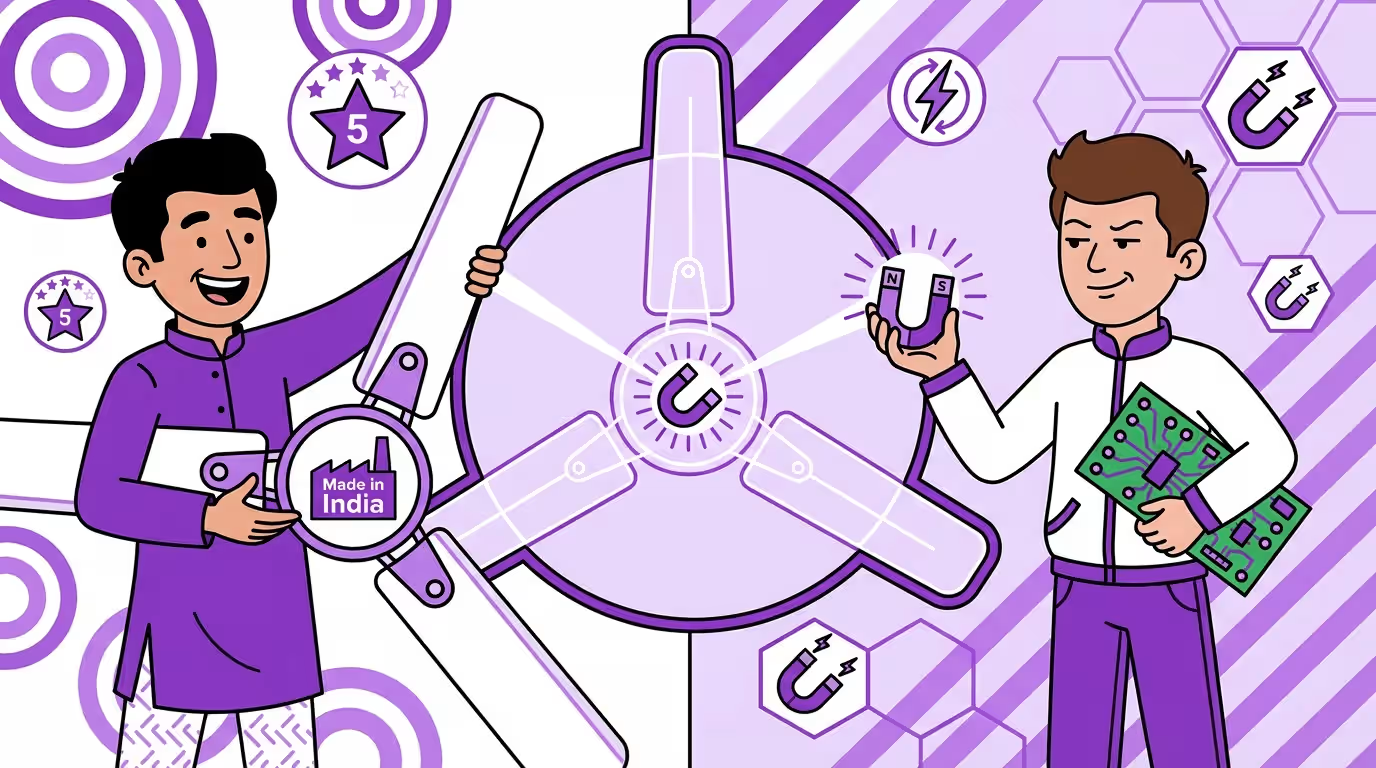
Every time a brand like KENT RO launches a shiny new BLDC fan promising “65% energy savings” and green credentials, we applaud. But nobody’s asking where the heart of that fan actually comes from — and the answer might make you uncomfortable.
When KENT RO’s Kühl brand unveiled its Fest B1 ceiling fan in January 2026 — drawing just 28 watts, boasting a 5-star BEE rating, and promising substantial electricity bill savings — the press release read like a textbook Atmanirbhar Bharat success story. A homegrown water purifier giant, proudly diversifying into premium energy-efficient appliances for Indian homes. Clean, green, local. Except it isn’t — not entirely.
The inconvenient truth buried inside almost every BLDC fan sold in India today, including the Kühl Fest B1, is a deep and structurally dangerous dependence on China for the two most critical components: rare-earth permanent magnets and motor-control electronics. Official trade data shows that India sourced between 84.8% and 90.4% of its permanent magnet imports from China by quantity between FY 2022–23 and 2024–25. Indian Kanoon You read that right — nine out of every ten magnets powering India’s “Made in India” fans arrived from China.
How Did We Get Here?
This dependency didn’t happen overnight. China has built an overwhelming dominance in rare-earth magnet manufacturing — controlling roughly 90% of global processing capacity and producing approximately 240,000 tonnes of rare earth permanent magnets annually as of 2023, a 14% year-on-year increase. Axios While China quietly invested over decades in the full rare-earth value chain — from mining to processing to magnet fabrication — India focused elsewhere.
The BEE’s mandatory star-labeling regulation for ceiling fans, which came into effect on January 1, 2023, turbocharged India’s BLDC fan market overnight. Suddenly, every manufacturer — from Atomberg and Crompton to new entrants like KENT’s Kühl — needed BLDC motors at scale. And scale meant China.
Then April 2025 happened. China imposed strict licensing requirements and fresh export restrictions on critical rare-earth elements — neodymium, terbium, scandium, and yttrium — sending shockwaves through global supply chains. Within two months, Chinese magnet exports plummeted by 75%, leaving India with barely two to three weeks of stock. Bar and Bench Maruti Suzuki and Bajaj Auto warned of potential production halts. The fan industry, far less vocal, faced the same silent squeeze.
The Facts Brands Aren’t Telling You
Here’s what the glossy product launch events conveniently skip. China maintains control over approximately 90% of global rare-earth processing capacity — a concentration that creates single-point-of-failure risks across multiple strategic industries, extending beyond raw material processing to encompass the sophisticated metallurgical capabilities required for producing sintered neodymium-iron-boron magnets, the highest-performance permanent magnets currently available. Tracxn
India, despite ranking third globally in rare-earth reserves with an estimated 6.9 million tonnes, barely converts any of it into finished magnets domestically. India imported 93% of its rare-earth magnets from China in FY 2024–25, with stockpiles lasting only two to three weeks after China’s export restrictions kicked in. LawBeat
The government has responded — a ₹1,345 crore emergency package targeting magnet manufacturing was announced after the April 2025 crisis, and India’s demand for rare-earth permanent magnets is projected to double by 2030. But building processing capacity takes years, not months.
So What Does This Mean for Your Fan Purchase?
When KENT RO or Atomberg or Crompton badges a fan “Made in India,” the assembly likely is Indian. The plastic housing, the blades, the canopy — probably local. But the rare-earth magnet spinning silently inside that motor? Almost certainly processed in China. The control electronics driving that energy-efficient BLDC circuit? Often imported too.
None of this is illegal. None of it is unique to KENT RO — this is an industry-wide structural reality. But it does mean that India’s celebrated transition to energy-efficient fans, while environmentally important, is simultaneously deepening a strategic supply chain vulnerability that policymakers are only now scrambling to address.
The next time a brand tells you their fan is “proudly Indian,” it’s worth asking: which part?
