

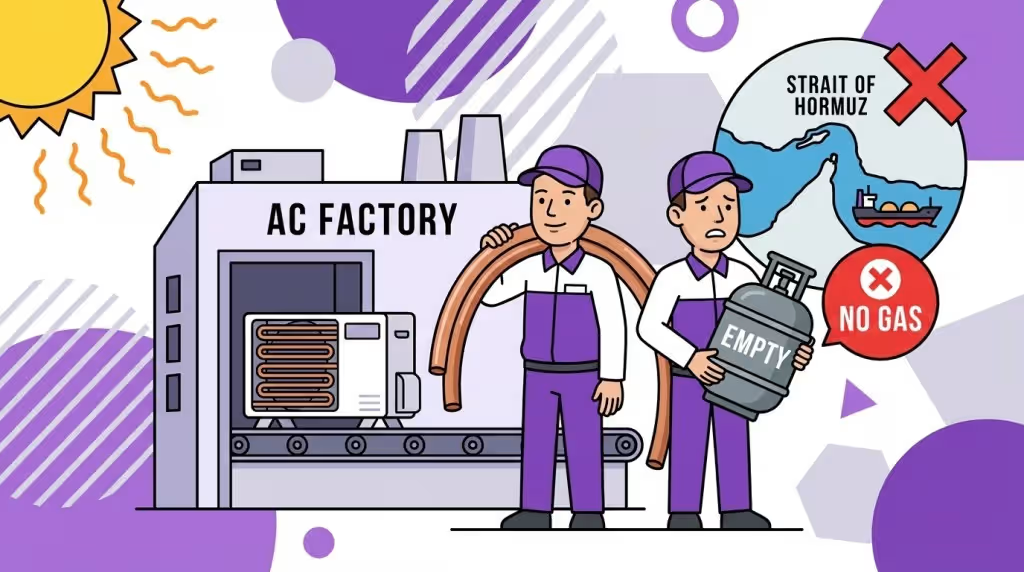
Just as India heads into its hottest months and air conditioner demand is set to explode, a geopolitical crisis halfway across the world is quietly choking the factories that make those ACs. The West Asia conflict has disrupted the Strait of Hormuz — and that’s a big deal for your next cooling purchase.
Here’s the thing: India imports roughly 60% of its LPG needs, and the Strait of Hormuz is the primary corridor for those shipments from Saudi Arabia and the UAE Outlook Business. When that route gets squeezed, the effects ripple far beyond your kitchen stove. AC manufacturers use LPG in processes like brazing and curing of powder-coatings — essentially joining the copper tubes that carry refrigerants through your air conditioner Business Standard. No gas, no tubes. No tubes, no AC.
Qatar Energy’s force majeure declaration at Ras Laffan — the world’s largest PNG liquefaction complex, handling 20% of global PNG supply — has sent Asian PNG spot prices soaring 65–75% since January 2026. Saudi Aramco’s simultaneous Ras Tanura shutdown has further tightened global LPG availability. Business Standard Industry players have been blunt: if this drags on, a complete production halt cannot be ruled out.
The government moved quickly. India invoked the Natural Gas (Supply Regulation) Order, 2026 under the Essential Commodities Act, ensuring 100% supply to households while rationing industrial allocations — manufacturing units receive around 80% of their six-month average, fertiliser plants 70%, and refineries just 65%. ScanX That sounds like a relief, until you realise the six-month reference window covers AC manufacturers’ off-season — meaning their baseline consumption figure is already unusually low.
Not everyone is sweating equally, though. Voltas MD Mukundan Menon confirmed the company’s plants rely on oxyacetylene rather than LPG: “We use oxyacetylene, so fortunately we are isolated from the issue as of now.” Business Standard That’s a quietly significant competitive edge right now. For Amber Enterprises and Blue Star, however, analysts at JM Financial warned that LPG brazing is a direct production bottleneck — and both companies are evaluating the situation as a potential production halt risk. ScanX
Meanwhile, the broader cost environment was already painful before this crisis hit. Copper prices have climbed from around $8,000 per tonne in early 2025 to roughly $13,000 per tonne now, and new BEE energy efficiency norms effective January 2026 are pushing 3-star AC prices up by 5% and 5-star models by 10–12% Business Standard — meaning consumers are already staring at 5–15% price hikes this summer.
Yet none of this is expected to kill demand. Industry forecasts peg 2026 AC sales at a 15% rise over 2024’s record of 14–15 million units, with longer-term targets of 25–30 million units annually by 2030. Business Standard India’s AC penetration remains low, summers are getting hotter, and first-time buyers aren’t going anywhere. Secondary sales volumes in Q4FY26 are already trending high, pointing to potential positive volume surprises Business Today even as the gas crisis clouds the supply picture.
The real story here isn’t that India’s AC market is in trouble — it isn’t. It’s that the companies that planned ahead on manufacturing flexibility are now watching their less-prepared rivals scramble. In a summer this competitive, that gap could matter.
